Understanding Dependencies
Dependencies define the order tasks must occur in. GlidePath supports all four standard CPM relationship types and allows you to fine-tune timing with lag and lead values.Feature Spec Reference
Module 4.1 — Relationship TypesThe Four Dependency Types
Finish-to-Start (FS)
The most common relationship. Task B cannot start until Task A finishes. Example: Site survey must finish before foundation excavation can start.Start-to-Start (SS)
Task B cannot start until Task A starts. Both tasks can proceed in parallel once the predecessor begins. Example: Concrete pour and curing monitoring start at the same time.Finish-to-Finish (FF)
Task B cannot finish until Task A finishes. Both tasks end together. Example: Commissioning documentation must finish when commissioning itself finishes.Start-to-Finish (SF)
The rarest relationship. Task B cannot finish until Task A starts. Rarely used in construction but useful in just-in-time scheduling. Example: New shift cannot finish until the replacement shift starts.Dependency Summary Table
Lag and Lead
Lag (Positive Delay)
A lag adds a waiting period between the predecessor and successor. Example: FS+3d means the successor starts 3 days after the predecessor finishes. Useful for curing times, delivery lead times, or approval wait periods.Lead (Negative Lag)
A lead allows overlap between the predecessor and successor by entering a negative lag. Example: FS-2d means the successor can start 2 days before the predecessor finishes. Useful when preparatory work can begin before the predecessor completes.Entering Lag/Lead
In the dependency picker:- Set the relationship type (FS, SS, FF, SF)
- Enter a number in the Lag field (positive for delay, negative for lead)
- Select the unit: Days, Hours, or % (percentage of predecessor duration)
How Dependencies Drive CPM
GlidePath’s CPM engine recalculates the schedule every time a dependency is added, changed, or removed:- Forward pass: Calculates the earliest start and finish for each task, respecting all predecessor relationships and lag.
- Backward pass: Calculates the latest start and finish without delaying the project end.
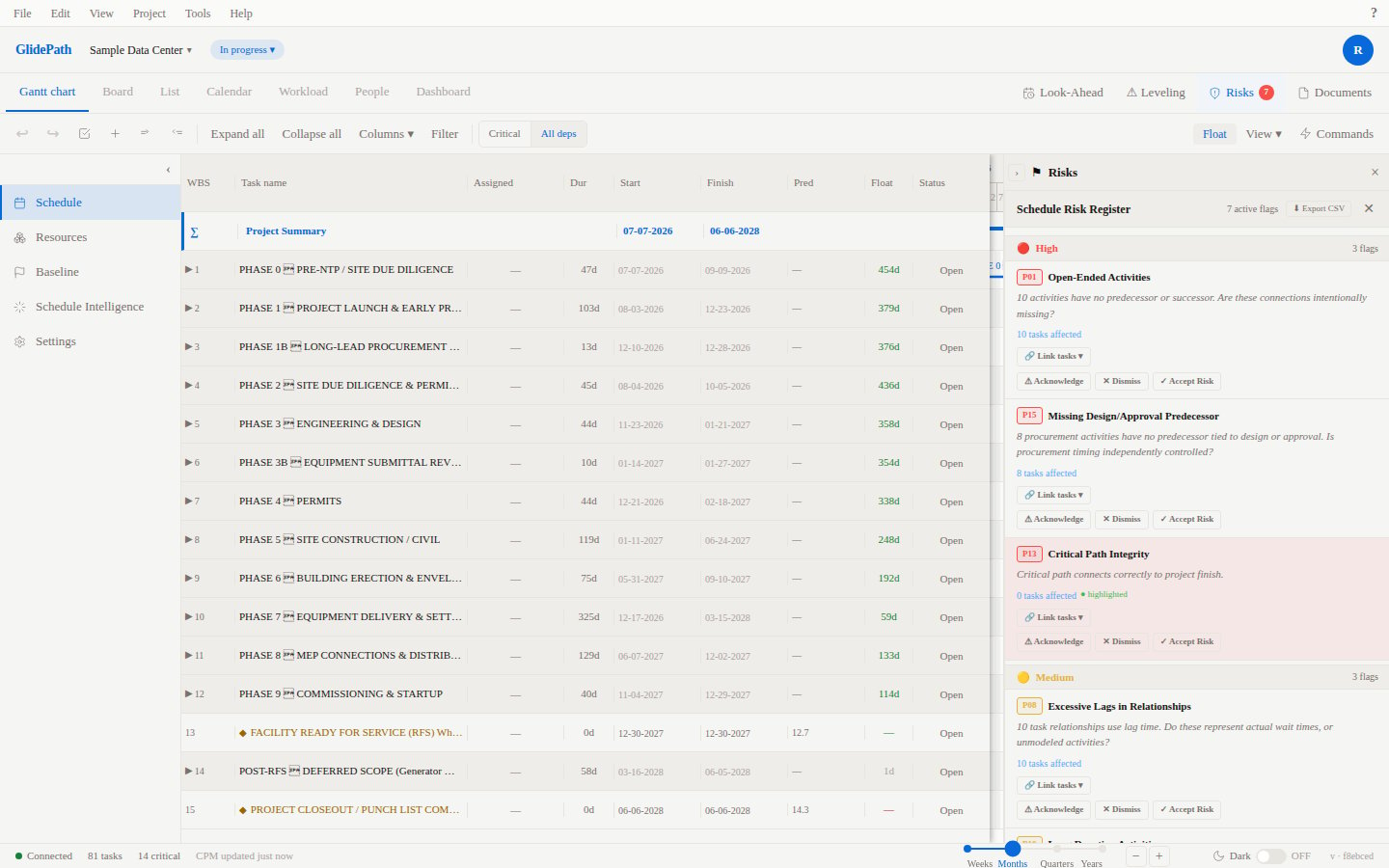
- Float/slack: The difference between earliest and latest dates. Tasks with zero float are on the critical path.
Screenshot